
 EN
EN
Evolving Industry Requirements for Non-Contact Laser Machining
Modern precision manufacturing continues to evolve toward complex, irregular workpiece structures that traditional mechanical processing methods struggle to support with stable quality output. Non-contact laser machining has become a mainstream processing method across global precision manufacturing fields, thanks to its unique ability to avoid physical extrusion, surface friction and structural deformation during material processing. Even with advanced optical systems equipped on modern laser machinery, equipment integrators still commonly encounter unstable contour consistency and uneven surface finish when producing complex curved and asymmetrical workpieces in continuous operation.
Long-term field experience in motion control system debugging and equipment optimization indicates that most recurring precision inconsistencies in laser forming are not caused by optical parameter errors or programming defects. Authoritative international precision motion research institutions have released industry analysis reports, pointing out that inherent mechanical structural defects and asynchronous multi-axis motion coordination are the core factors leading to flawed contour forming. Traditional servo systems built with multi-stage transmission structures produce cumulative microscopic positioning deviations during long-term continuous operation, failing to maintain stable and repeatable trajectory tracking for complex irregular workpiece profiles. Against the backdrop of upgraded manufacturing precision standards, highprecision direct drive type servo architecture has become an essential structural upgrade to stabilize the overall operational performance of modern laser processing equipment.
Direct Drive Structural Optimization Eliminates Inherent Mechanical Errors
Most conventional servo systems used in standard laser processing equipment rely on reducers, timing belts and coupling assemblies for power transmission. Although these components are widely adopted in traditional mechanical design solutions, they inevitably generate tiny structural gaps and mechanical resonance during high-frequency dynamic movement. For non-contact laser machining, a processing mode that highly depends on ultra-stable and smooth trajectory positioning, these subtle mechanical defects will gradually accumulate, resulting in distorted curved edges, uneven surface texture and inconsistent dimensional uniformity of finished special-shaped workpieces.
Highprecision direct drive type servo systems completely abandon traditional multi-stage transmission structures and adopt a direct connection structure between drive motors and equipment execution components. This structural innovation fundamentally eliminates all positioning error sources derived from mechanical gaps and elastic deformation. Equipped with industrial-grade multi-point precision compensation algorithms, the system dynamically calibrates micro-level positioning offsets in real time during complex curved path operation. Built-in intelligent vibration suppression modules effectively weaken high-frequency structural resonance generated by frequent direction switching and contour transition. Mass field verification on various complex structural workpieces proves that direct drive configurations deliver far more stable trajectory accuracy and contour consistency compared with traditional servo structures. The compact integrated layout also optimizes the internal space structure of laser equipment, improving overall structural simplicity and assembly compatibility.
Multi-Axis Synchronization Mechanism Stabilizes Complex Contour Machining Consistency
Irregular special-shaped workpieces feature variable radian distribution and asymmetric structural characteristics, requiring highly consistent collaborative linkage of multiple motion axes throughout the laser forming process. Most traditional servo devices operate based on independent single-axis control logic, lacking unified timing calibration and real-time data interaction mechanisms between axes. In continuous contour processing, subtle asynchronous motion will create deviations between the actual moving path and the preset machining trajectory, resulting in unstable forming quality of complex workpieces.
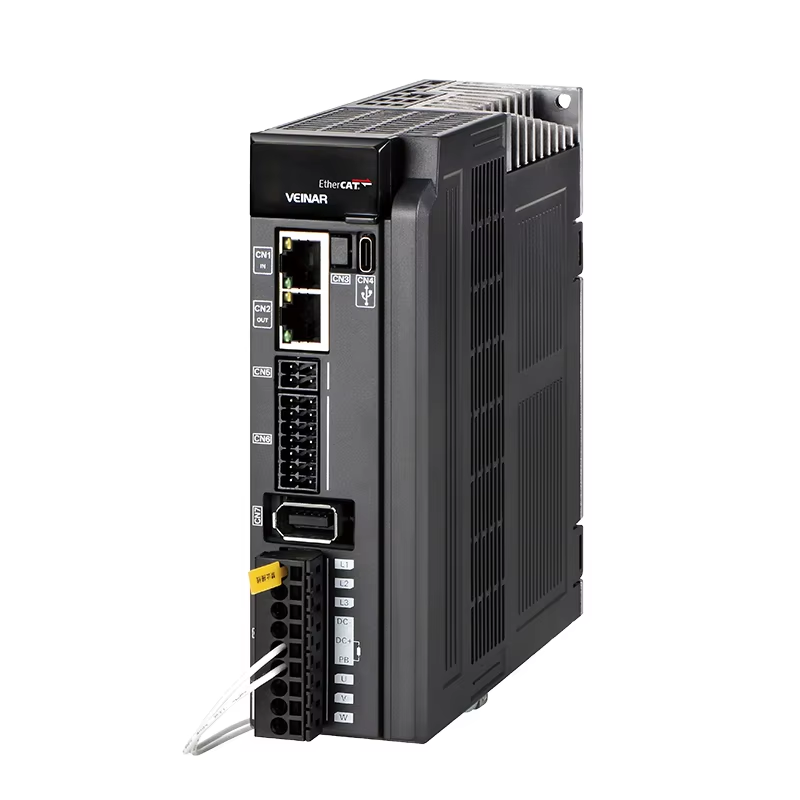
Highprecision direct drive servo platforms adopt industry-verified multi-axis collaborative control logic and professional gantry synchronization algorithms optimized for complex contour scenarios. The hardware natively supports mainstream industrial communication protocols including EtherCAT, Modbus and Profinet, realizing ultra-low-latency data synchronization among all motion units. The independent positioning system can accurately identify and fit irregular curved paths, maintaining stable coordinate alignment throughout the whole machining cycle. This reliable synchronization framework achieves consistent motion coordination for various complex structural workpieces, effectively improving the long-term operational stability of non-contact laser machining systems.
Universal Hardware Compatibility Improves Equipment Structural Versatility
Modern laser processing machinery features diversified structural designs and unified industrial electrical specifications, putting forward high requirements for the compatibility and scalability of core motion control components. Most general-purpose servo drives have limited matching adaptability, unable to fit diverse motor types and high-precision encoder specifications commonly used in laser equipment. This limited compatibility forces equipment developers to repeatedly adjust electrical circuits and structural layouts during equipment iteration, increasing overall R&D difficulty and structural adaptation costs.
Highprecision direct drive type servo products support universal matching with mainstream rotary motors, linear motors and industrial encoders in the global automation industry. The complete product matrix covers multiple voltage specifications and structural models, fully adapting to different configuration standards of modern laser machinery. Standardized electrical interfaces and unified control logic avoid repetitive electrical debugging and structural modification work in equipment integration. This highly adaptable hardware architecture enables direct drive servo units to be stably embedded in various laser equipment structures, providing reliable and unified motion control support for complex contour non-contact processing scenarios.
Modular Design Simplifies Long-Term Equipment Operation and Management
Traditional discrete servo control structures disperse motion control units into independent single-axis modules, requiring separate parameter calibration, status inspection and fault diagnosis for each motion unit. This decentralized management mode increases the complexity of daily equipment operation and routine inspection work. At the same time, wearable intermediate transmission components will gradually age during long-term continuous operation, raising potential operational instability risks.
The integrated modular design of highprecision direct drive servo systems optimizes the overall control architecture of laser processing equipment. All connected motion axes are uniformly managed through a unified control terminal, simplifying daily parameter debugging and real-time operating status monitoring. The complete cancellation of wearable transmission structures reduces long-term equipment aging risks and lowers routine maintenance complexity. With real-time operating data feedback supported by industrial Ethernet buses, technical teams can accurately grasp the operating status of motion units and quickly locate abnormal conditions, reducing the technical threshold of daily equipment management and improving long-term operational reliability.
Standardized Manufacturing System Ensures Consistent Hardware Stability
Stable industrial-grade performance of direct drive servo hardware relies on professional technical iteration and rigorous standardized manufacturing management, rather than simple component assembly. Highsense gathers professional motion control research talents from China and Germany, with long-term technical accumulation in servo algorithm optimization and structural design upgrading. Every batch of servo products undergoes complete standardized production and testing procedures, including strict incoming material inspection, professional program calibration, full-performance testing and long-term aging verification, ensuring stable and consistent quality for all finished products.
Equipped with a mature global supply chain layout and standardized mass production system, Highsense provides high-stability direct drive motion control components for global precision processing equipment. The brand’s comprehensive product layout and strict manufacturing standards deliver reliable core hardware support for structural optimization and performance upgrading of modern laser machinery, creating stable long-term application value for global precision manufacturing systems.
Conclusion
Highprecision direct drive type servo technology effectively solves the inherent structural defects and precision instability problems of traditional servo systems in special-shaped workpiece non-contact laser machining. With transmission-free structural design, stable multi-axis synchronization performance, universal hardware compatibility and simplified modular management logic, direct drive servo systems provide high-reliability motion control solutions for complex contour precision processing. As complex custom workpiece structures become more widely adopted in global precision manufacturing, direct drive motion control technology will continue to act as the core hardware foundation for the intelligent upgrading and structural iteration of modern laser processing equipment.
Table of Contents
- Evolving Industry Requirements for Non-Contact Laser Machining
- Direct Drive Structural Optimization Eliminates Inherent Mechanical Errors
- Multi-Axis Synchronization Mechanism Stabilizes Complex Contour Machining Consistency
- Universal Hardware Compatibility Improves Equipment Structural Versatility
- Modular Design Simplifies Long-Term Equipment Operation and Management
- Standardized Manufacturing System Ensures Consistent Hardware Stability
- Conclusion