
 EN
EN
Engineering Realities in Aerospace Machining and the Shift to Robotic Automation
Machining structural aerospace components such as intricate turbine brackets, thin-walled airframe ribs, and complex engine housings requires an absolute commitment to geometric integrity and surface perfection. For decades, heavy gantry milling machines dominated this space, yet they constantly battle physical workspace limitations when handling oversized or deep-pocket geometries. To bypass these dimensional constraints and unlock greater operational agility, modern smart manufacturing plants are rapidly integrating robotic machining systems. Deploying a sophisticated 6axis robotic arm multiaxis servo configuration grants engineers the multi-angle tool orientation and spatial flexibility needed to reach awkward undercuts. However, unlike massive cast-iron machine beds, articulated robotic arms possess inherently lower structural stiffness. They are vulnerable to environmental temperature swings and gravitational deflection, meaning that maintaining sub-micron dynamic positioning accuracy across a large spatial envelope requires far more than standard factory calibration.
Decoupling Thermal Elongation and Mechanical Hysteresis
During extended aerospace milling campaigns, continuous motor torque execution and heavy mechanical friction generate massive amounts of thermal energy inside joint gearboxes and internal drivetrains. This steady thermal buildup causes non-linear physical expansion across structural links, resulting in progressive dimensional drift that quietly ruins tool center point accuracy over hours of unattended operation. At the same time, mechanical backlash within high-ratio speed reducers and harmonic drives introduces annoying hysteresis, particularly whenever joint rotation directions abruptly reverse during aggressive contouring paths. When combined with mechanical compliance under heavy cutting loads, these factors create severe dynamic errors that traditional static calibration routines simply cannot fix. In an articulated kinematic chain, a minuscule angular error originating at a base joint propagates exponentially outward to the end-effector. Without active, real-time compensation, thermal growth and mechanical backlash inevitably cause chatter marks, out-of-tolerance dimensions, and painful scrap rates on expensive exotic alloy parts.
Architecting High Bandwidth Motion Control and Real-Time Synchronization
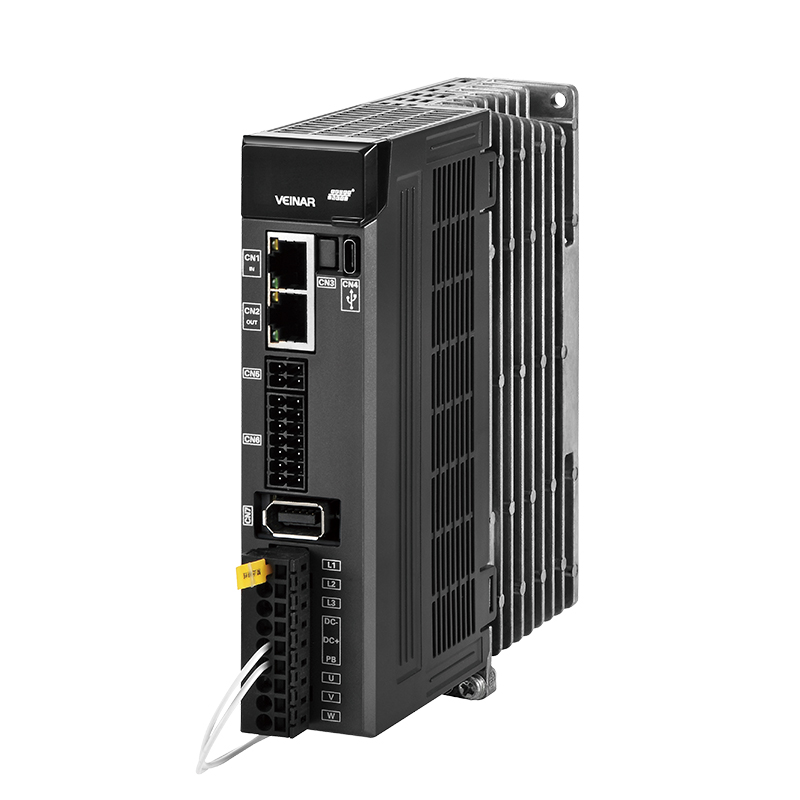
Overcoming these systemic physical roadblocks demands an advanced control architecture capable of unifying multi-axis synchronization with lightning-fast deterministic feedback loops. Integrating an industrial 6axis robotic arm multiaxis servo layout powered by Highsense multi-axis servo drives establishes the foundational hardware capability required for high-bandwidth motion coordination. By leveraging real-time industrial Ethernet protocols like EtherCAT and Profinet, the central motion controller continuously swaps position, velocity, and torque telemetry with every single joint drive at microsecond intervals. Advanced multi-axis servo drives consolidate drive logic across all six articulated joints into a unified power unit, practically eliminating inter-axis communication lag and shielding the system from electromagnetic interference. High-resolution optical and inductive encoders stream precise position updates straight into advanced vector control loops, enabling the system to actively suppress torque ripple, smooth out trajectory velocities, and execute precise feed-forward adjustments before the cutter even meets the material.
Implementing Volumetric Compensation via Multi-Point Spatial Mapping
To systematically eradicate non-linear kinematic errors, thermal drift, and spatial backlash, high-end production facilities rely on an exhaustive volumetric accuracy compensation framework. Field engineers utilize laser trackers and optical coordinate measurement systems to map the entire three-dimensional working volume of the robotic arm across thousands of discrete coordinate points under varying ambient temperatures. The resulting spatial distortion matrix thoroughly models joint offsets, structural bending, and temperature-dependent expansion vectors across the complete operating envelope. By embedding this comprehensive volumetric calibration dataset straight into the multi-axis servo drive firmware, the system computes real-time correction vectors on the fly. As the robotic arm executes complex toolpaths, the servo controller applies instantaneous sub-micron positional offsets to every joint axis, effectively neutralizing mechanical backlash and thermal elongation before tool-to-workpiece contact occurs. This closed-loop volumetric strategy transforms flexible robotic joints into an ultra-rigid, highly repeatable manufacturing platform.
Translating Micron-Level Precision into Measurable Commercial Value
Achieving micron-level machining precision directly translates into massive financial and operational benefits for global industrial supply chains. By eliminating thermal drift and mechanical backlash through advanced multi-axis control, manufacturers can drastically cut down component scrap rates, protect expensive cutting tools from premature micro-chipping, and achieve mirror-like surface finishes that pass stringent non-destructive testing on the first try. Highsense delivers mission-critical motion control solutions backed by decades of Sino-German research and development expertise, offering robust manufacturing capabilities and reliable global supply chain services that empower industrial enterprises to scale confidently. Through continuous innovation in compact multi-axis servo architecture, universal encoder compatibility, and engineering excellence, Highsense consistently drives automation performance forward, helping global manufacturers turn complex technical challenges into enduring competitive advantages.
Table of Contents
- Engineering Realities in Aerospace Machining and the Shift to Robotic Automation
- Decoupling Thermal Elongation and Mechanical Hysteresis
- Architecting High Bandwidth Motion Control and Real-Time Synchronization
- Implementing Volumetric Compensation via Multi-Point Spatial Mapping
- Translating Micron-Level Precision into Measurable Commercial Value