
 EN
EN
Evolving Industry Requirements for Non-Contact Laser Machining
Modern precision manufacturing is steadily shifting toward complex, irregular workpiece designs that traditional mechanical machining struggles to accommodate. Non-contact laser processing has become a mainstream manufacturing method thanks to its ability to avoid physical extrusion, surface abrasion and structural deformation during material processing. Even so, many equipment integrators face consistent structural limitations when running continuous contour machining for special-shaped workpieces. Field observations from long-term motion control debugging projects reveal that conventional servo systems with indirect transmission structures cannot maintain stable and consistent motion trajectories on complex curved and asymmetrical workpiece surfaces.
Authoritative industrial automation research institutions have summarized in industry technical reports that most contour defects in laser forming stem from mechanical structural errors and unsynchronized axis movement, rather than optical or software parameter issues. Traditional servo layouts with intermediate transmission parts create inherent structural errors that accumulate during continuous dynamic operation, resulting in inconsistent contour uniformity on finished workpieces. As manufacturing design standards grow more sophisticated, the industry requires upgraded motion control hardware that can adapt to diverse special-shaped contour processing without relying on complicated manual parameter calibration. Highprecision direct drive type servo structures have emerged as a reliable structural upgrade to resolve these long-standing laser motion control pain points.
Direct Drive Structural Optimization Eliminates Inherent Mechanical Errors
The biggest structural defect of traditional servo configurations for laser equipment lies in redundant intermediate transmission components, including reducers, synchronous belts and connecting couplings. These mechanical accessories are necessary for conventional power transmission but introduce unavoidable microscopic backlash and structural jitter during high-frequency dynamic operation. For non-contact laser machining, which relies on ultra-precise trajectory positioning to complete contour forming, even tiny structural deviations can lead to uneven surface texture and distorted workpiece outlines.
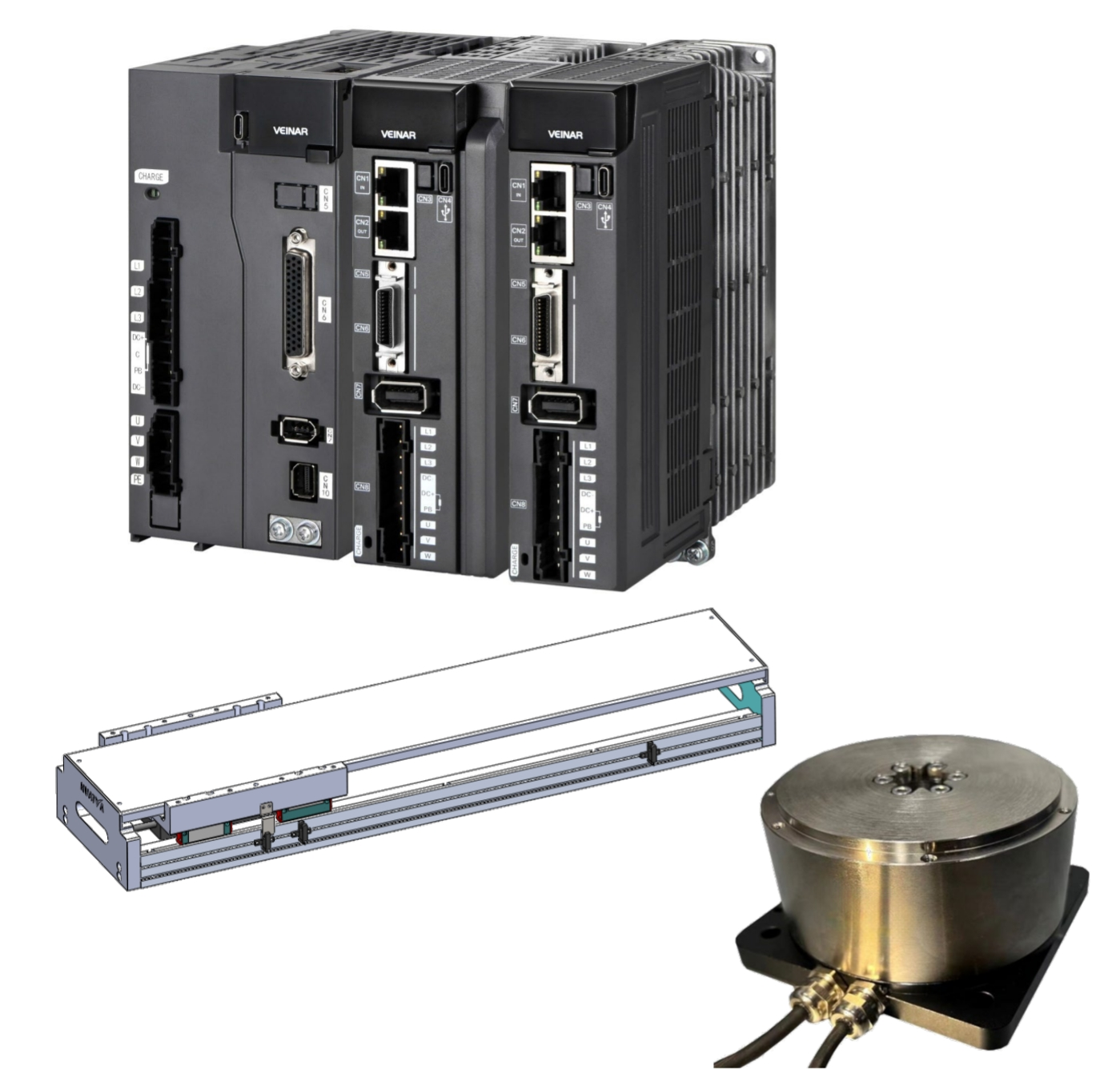
Highprecision direct drive type servo systems completely abandon indirect transmission structures, adopting a direct connection mode between the drive motor and equipment execution components. This streamlined physical structure removes all error sources caused by mechanical transmission gaps. Built-in 1000-point precision compensation algorithms dynamically calibrate microscopic positioning offsets during operation, while professional vibration suppression modules effectively weaken high-frequency resonance generated during frequent direction switching and contour conversion. Verified through repeated equipment debugging and structural comparison tests, direct drive motion architectures deliver far higher trajectory stability for complex irregular workpieces compared with traditional servo combinations. The compact and integrated structural design also optimizes the internal space layout of laser equipment, making the overall mechanical structure more concise and adaptable for diverse equipment assembly structures.
Multi-Axis Synchronization Mechanism Stabilizes Complex Contour Machining Consistency
Special-shaped workpieces feature irregular radian changes and asymmetric structural designs, requiring multiple equipment axes to maintain highly coordinated linkage during laser processing. Ordinary servo systems only support basic independent axis operation, lacking unified clock calibration and real-time data interaction mechanisms. In continuous contour processing, subtle asynchronous operation between axes will cause deviation between the actual laser moving track and the preset machining path, affecting the overall structural uniformity of finished workpieces.
Highprecision direct drive servo platforms are built with mature multi-axis collaborative control logic and professional gantry synchronization algorithms optimized for contour machining scenarios. The systems maintain native compatibility with mainstream industrial bus protocols including EtherCAT, Modbus and Profinet, realizing high-speed and low-delay data interaction between all motion units. Equipped with independent two-dimensional PSO positioning control logic, the hardware can accurately identify and track complex curved paths, ensuring every moving coordinate matches the design trajectory stably. This standardized multi-axis synchronization mode adapts to various complex contour processing requirements, maintaining consistent motion coordination whether processing micro-sized special-shaped structures or large-format curved workpieces.
Universal Hardware Compatibility Improves Equipment Structural Versatility
Laser processing equipment involves diverse mechanical structures and electrical configuration standards, placing high requirements on the compatibility of core motion control components. Many ordinary servo drives have single matching specifications, which cannot adapt to different motor types and encoder standards, resulting in poor versatility and limited equipment iteration space. For equipment manufacturers focusing on structural upgrading and standardized iteration, incompatible hardware will increase the difficulty of electrical design and equipment assembly.
Highprecision direct drive type servo products support universal matching with rotary motors, linear motors and most mainstream encoder specifications in the industry. The complete product matrix covers multiple voltage specifications and structural models, which can adapt to different structural designs and configuration standards of laser processing equipment. Standardized electrical interfaces and unified control logic reduce repeated electrical design work for equipment integration. The highly compatible hardware architecture allows motion control components to be stably embedded in various laser equipment structures, providing unified and reliable motion support for different contour machining demands.
Modular Design Simplifies Long-Term Equipment Operation and Management
Complex structural configuration and scattered control units make traditional servo equipment tedious in daily management and parameter maintenance. Discrete servo structures require separate inspection and calibration for each motion unit, increasing the complexity of daily equipment management. In addition, vulnerable intermediate transmission parts raise the frequency of structural inspection and component maintenance, affecting the long-term stable operation of equipment.
The integrated modular design of highprecision direct drive servo optimizes the overall control architecture of laser equipment. Unified parameter management terminals and standardized operation logic simplify daily equipment debugging and status monitoring. The cancellation of vulnerable transmission structures reduces the complexity of long-term equipment maintenance. Real-time operating data feedback based on industrial Ethernet buses supports accurate equipment status monitoring, helping maintenance personnel quickly grasp the operating state of motion units and complete standardized equipment management. This structural optimization greatly improves the stability of long-term equipment operation and reduces the threshold of daily equipment management.
Standardized Manufacturing Strength Ensures Consistent Product Stability
Stable performance of highprecision direct drive servo hardware relies on rigorous technical iteration and standardized manufacturing systems. Highsense leverages a professional R&D team composed of Chinese and German motion control experts, with decades of technical accumulation in servo drive structural design and algorithm optimization. All products follow standardized and complete production procedures, including strict incoming material inspection, program calibration, performance testing and long-term aging verification, ensuring every batch of equipment maintains consistent industrial-grade stability.
With a mature global supply chain system and standardized production management mechanisms, Highsense delivers highly stable direct drive motion control components for automated processing equipment worldwide. The brand’s complete product layout and standardized manufacturing capabilities provide reliable core hardware support for the structural upgrading and iterative optimization of modern laser processing equipment, creating stable structural value for long-term equipment operation.
Conclusion
Highprecision direct drive type servo technology effectively solves the structural motion control problems faced by laser processing equipment in special-shaped workpiece non-contact machining. Through structural optimization, stable multi-axis synchronization, universal hardware compatibility and simplified management logic, direct drive servo systems provide a more stable and reliable motion control solution for complex contour processing. As the structural design of industrial workpieces becomes more diverse, direct drive motion control technology will continue to serve as the core hardware support for the upgrading of modern laser processing equipment, promoting the standardized development of precision non-contact machining technology.
Table of Contents
- Evolving Industry Requirements for Non-Contact Laser Machining
- Direct Drive Structural Optimization Eliminates Inherent Mechanical Errors
- Multi-Axis Synchronization Mechanism Stabilizes Complex Contour Machining Consistency
- Universal Hardware Compatibility Improves Equipment Structural Versatility
- Modular Design Simplifies Long-Term Equipment Operation and Management
- Standardized Manufacturing Strength Ensures Consistent Product Stability
- Conclusion