
 EN
EN

Deterministic Synchronization: Sub-100 ns Jitter for Precision Multi-axis Coordination
How Distributed Clocks Eliminate Timing Drift in 6-axis Robotic Palletizer Applications
Multi-axis motion control demands near-perfect timing across all axes. In a 6-axis robotic palletizer, even a few microseconds of drift can cause missed positions or jerky movements. EtherCAT’s distributed clocks (DC) architecture solves this by synchronizing each drive’s local clock to the master’s reference with sub-100 ns jitter—achieving deterministic timing without software-based corrections. Unlike periodic synchronization protocols that accumulate error, DC uses a hardware-based mechanism to continuously adjust each node’s clock in real time. This eliminates timing drift entirely, ensuring all six axes move in lockstep.
The result is consistent path accuracy and smooth coordinated motion—critical for high-speed palletizing where variable loads demand precise, lag-free response. For example, when picking and placing heavy cartons at cycle rates exceeding 120 cycles/hour, sub-microsecond synchronization prevents ripple errors that could misalign the gripper or damage product. It also reduces mechanical wear by eliminating unnecessary position corrections from software sync loops. By leveraging distributed clocks, engineers achieve reliable, repeatable multi-axis coordination without complex external timing hardware—meeting the stringent timing requirements defined in IEC 61800-7 for servo drive interoperability.
System-Level Efficiency: Wiring Simplification, Space Savings, and Common DC Bus Energy Recovery
Reducing Cabinet Footprint and Total Cost of Ownership in Multi-axis Drive Deployments
Multi-axis EtherCAT drives dramatically cut system-level complexity by consolidating power and communication into a single cable per axis. This wiring simplification shrinks cabinet volume—typical installations reduce footprint by 30–40% compared to traditional single-axis architectures. The shared DC bus design captures regenerative energy from decelerating axes, such as a lowering vertical axis, and reuses it to power motoring loads elsewhere in the system. This eliminates braking resistors and significantly reduces heat dissipation, lowering enclosure cooling requirements.
Fewer components and smaller cabinets directly reduce material costs and installation labor. Over the machine lifecycle, energy recovery from the common DC bus improves total cost of ownership: field deployments show payback periods under 18 months for multi-axis systems powering 6-axis robotic palletizers. These gains align with ISO 50001 energy management principles and are validated through third-party efficiency testing per IEC 61800-9-2.
Accelerated Integration: Plug-and-Play Commissioning and Seamless PLC/SCADA Interoperability
Modern multi-axis EtherCAT drives accelerate commissioning through intelligent auto-recognition and network self-configuration.
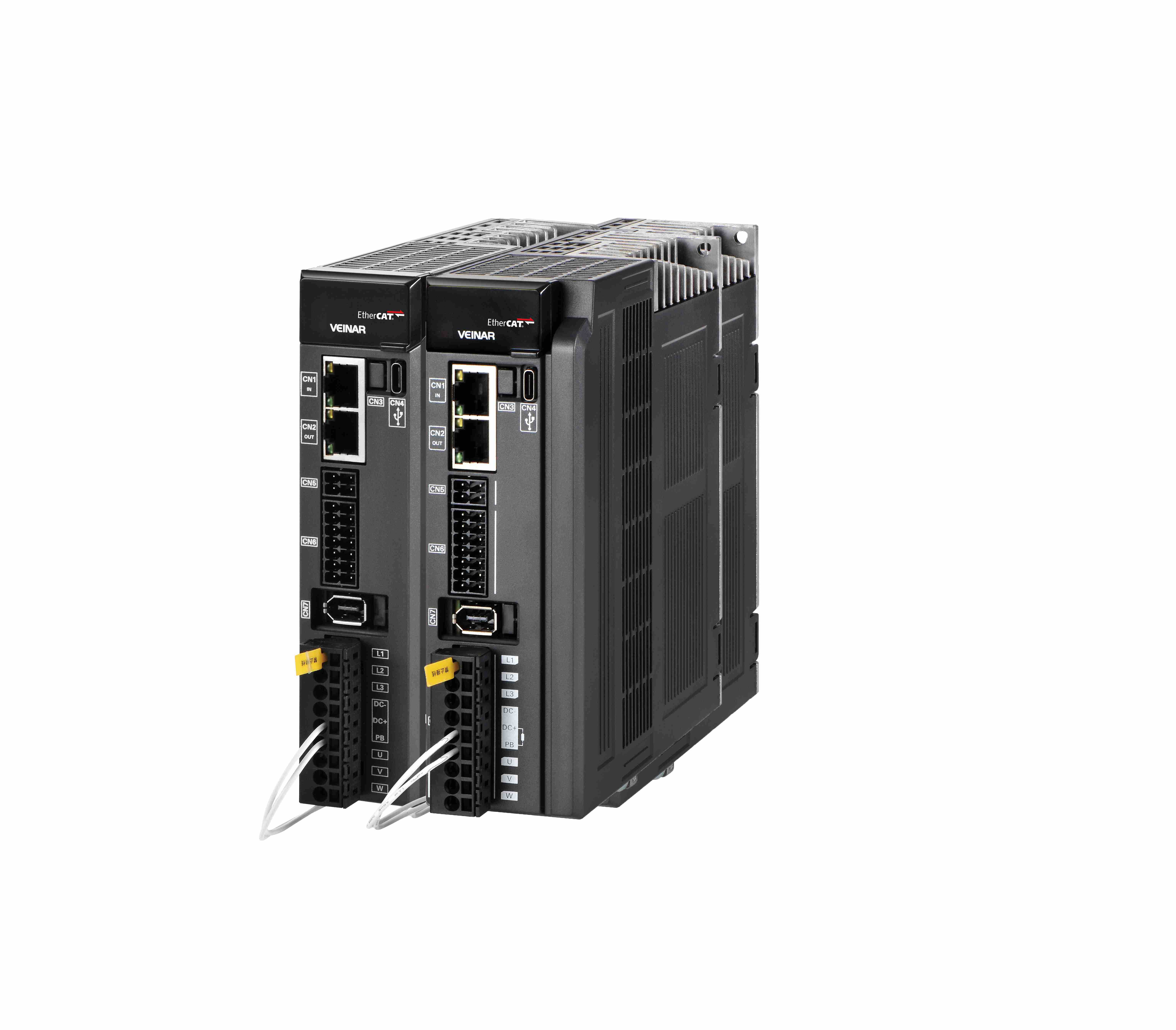
Auto-ID Servo Recognition and Elimination of Manual I/O Mapping in Multi-axis EtherCAT Networks
With auto-ID servo recognition, each servo drive in a multi-axis EtherCAT network is identified and configured automatically upon power-up. The controller reads the drive’s electronic nameplate (per IEC 61800-7), assigns a unique node address, and loads the correct motion parameters—eliminating manual I/O mapping and axis assignment. For a 6-axis robotic palletizer, this means the full set of drives, motors, and feedback devices synchronizes with the PLC or SCADA system within minutes.
Commissioning time shrinks from days to hours, and human errors from incorrect wiring or parameter entry are avoided. The same auto-ID mechanism enables true plug-and-play replacement: a failed drive is swapped and recognized instantly without reprogramming. Real-time diagnostics and performance data flow natively into SCADA interfaces—no additional configuration required—enabling proactive maintenance and reducing unplanned downtime. As a result, engineers focus on optimizing process logic rather than integration overhead, delivering faster time-to-production and higher system reliability than conventional servo architectures.
Real-World Validation: From Theory to ±0.005 mm Repeatability in a 6-Axis Robotic Palletizer
The theoretical advantages of multi-axis EtherCAT drives translate directly into measurable performance gains. In production deployments of 6-axis robotic palletizers, system integrators have achieved consistent positioning repeatability of ±0.005 mm—validated per ISO 9283 methodology. This represents a tenfold improvement over conventional fieldbus-based systems, which typically deliver ±0.02 to ±0.05 mm in comparable applications.
This precision stems directly from deterministic synchronization: sub-100 ns jitter and drift-free distributed clocks ensure the end-effector returns to the same Cartesian point within a 0.01 mm sphere. The outcome is reliable pick-and-place cycles for fragile or tightly toleranced payloads, reduced scrap rates, and increased throughput. For packaging operations demanding flawless alignment—such as case packing or secondary palletizing—the 6-axis robotic palletizer equipped with multi-axis EtherCAT drives is not aspirational; it is a field-proven, production-ready solution.
Table of Contents
- Deterministic Synchronization: Sub-100 ns Jitter for Precision Multi-axis Coordination
- System-Level Efficiency: Wiring Simplification, Space Savings, and Common DC Bus Energy Recovery
- Accelerated Integration: Plug-and-Play Commissioning and Seamless PLC/SCADA Interoperability
- Real-World Validation: From Theory to ±0.005 mm Repeatability in a 6-Axis Robotic Palletizer